Behind the Mask
A personality-archetype game I designed end-to-end and shipped solo, with AI as the engineering team.
Context
Archetypes and personas sit at the center of how I design — but off-the-shelf systems were always too clinical, generic, or abstract to land in real product decisions. So over years I kept my own notes on behavioral patterns. Behind the Mask is the result: 48 archetypes across 6 clusters, each with a virtue and a shadow.
- Momentum & Action
- Stability & Grounding
- Insight & Awareness
- Care & Support
- Structure & Direction
- Adaptation & Resilience
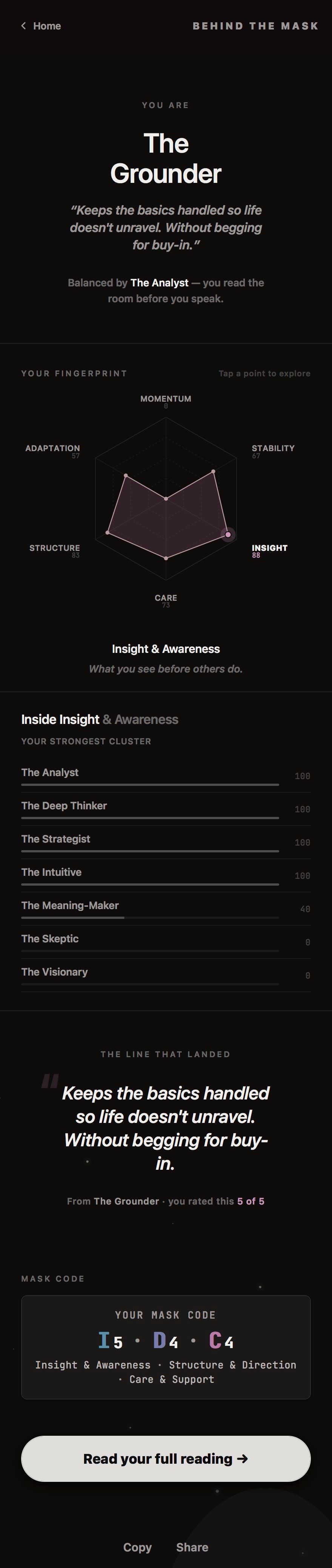
Six clusters group 48 archetypes. Each archetype carries both a virtue and a shadow.
Role & scope
Solo designer — system design, game design, content design, UX/UI, frontend implementation, and brand. Stack: React / TypeScript, Anthropic Claude API, Vercel.
Play it now
We all act differently depending on the moment. Calm in a crisis, quick to go quiet in an argument. The first to step in, or the one who hangs back and watches. None of it is good or bad — it’s just how each of us moves through things. This game is a way to notice that, together. You look at small, real situations — someone drops their groceries, a plan falls apart, a hard conversation needs to happen — and think about who’d step into that moment, and how. Sometimes you’re guessing about a stranger. Sometimes how your friends would act. Sometimes how they’d describe you — which is usually where it gets interesting. There are no right answers about who you are. It’s the conversation after that’s worth playing for. You can play alone and just reflect, or with a group and let it get loud.
Four modes — Solo, Team, Scenarios, and Quotes. Solo ends with an AI-generated personality read. Everything in the frame is live.
The hard calls
- Reflective, not diagnostic. No scores, no "you are this." Archetypes are situational tendencies, not identities — every downstream decision flows from this.
- Ambiguity as a feature. Most scenarios have several plausible fits; the system stores a plausible-fit set, not one right answer, and the reveal celebrates the debate.
- Four modes, one system. Solo, Team, Scenarios, and Quotes are functionally different products sharing one archetype model.
- The fingerprint is the spine. Every mode resolves to the same cluster-radar primitive with different data — built once, which made later modes nearly free.
What AI made possible
I'm not an engineer; a year ago this wouldn't have shipped. AI handled implementation, but the bigger shift was using it as a design thinking partner — pushing back, finding seams, catching features that were two features pretending to be one. What I'd do differently: separate the design thread from the engineering thread earlier.
Outcome
Shipped solo in ~4 weeks: 48 archetypes, 6 clusters, 4 modes, live with AI-generated personality reads. The distance from insight to a thing real people can use has collapsed — one designer can now ship a hypothesis and iterate the next morning.
What surprised me was how often Team Mode debates outlasted the game itself.